The CRNA Shortage is Structural. Hospitals Aren't Ready


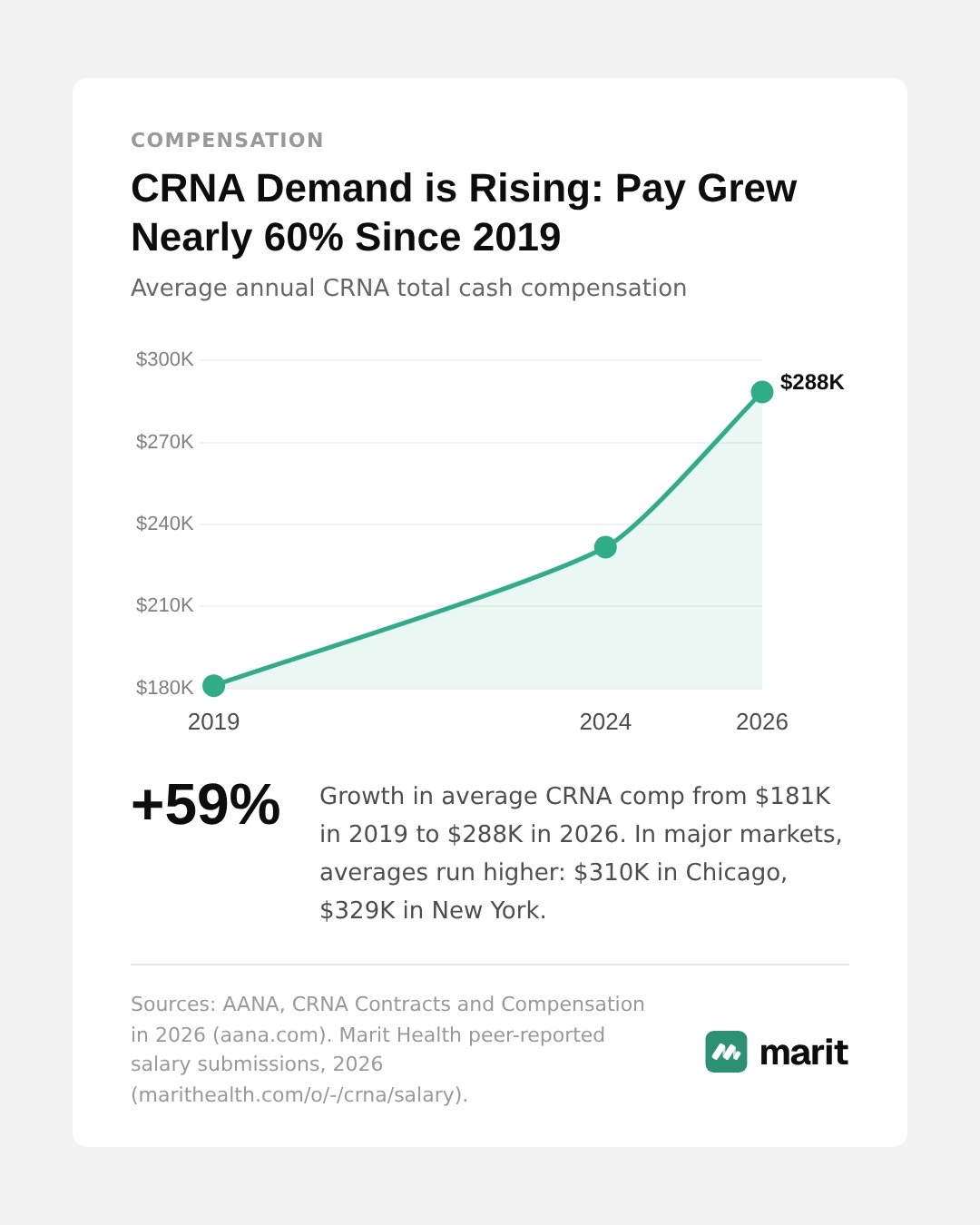
Today, Certified Registered Nurse Anesthetists (CRNAs) earn an average of $288,441 a year, and pay has climbed nearly 60% since 2019. In major metro markets, the average runs higher: $310,000 in Chicago, $329,000 in New York.
Why the increase? The economics are straightforward: pay is up because CRNAs are one of the most in-demand jobs in medicine.
The operating room generates 60-70% of total hospital revenue. But the physician anesthesiologist workforce is shrinking while anesthesia demand expands, and hospitals are leaning harder on CRNAs to fill the gap.
Here are five reasons why CRNA pay and demand have accelerated.
Job outlook for CRNAs: Five reasons demand is up
1. Demand for anesthesia services has expanded beyond the OR.
Surgical demand was already climbing before COVID-19, and it accelerated sharply as elective procedures resumed. Due to an aging population that requires more joint replacements, cardiac procedures, and cancer surgeries, operating room volumes rose far past the normal baseline.
Further, anesthesia is no longer confined solely to the operating room. Endoscopy suites, cardiac catheterization labs, office-based procedures, interventional radiology, and MRI units now require the same coverage the OR always has, a category known as Non-Operating Room Anesthesia (NORA). These procedures are projected to account for over 50% of all anesthetics delivered by 2030.
2. The number of CRNA graduates doesn’t outpace retirees
According to the AANA, approximately 2,400 CRNAs graduate annually from 155 accredited programs nationwide. That number sounds substantial until set against the retirement math: roughly 31% of the current CRNA workforce is 55 or older, meaning retirements are accelerating at the same pace as demand. Annual graduates are largely offsetting departures rather than growing the workforce.
As of 2025, all newly graduating CRNAs are required to hold doctoral degrees. That raises the standard of training but extends the path to practice and constrains how quickly new programs can scale. The CRNA shortage won’t be fixed in the short-term.
3. The anesthesiologist workforce is contracting in parallel
Approximately 30% of practicing anesthesiologists are projected to exit clinical practice by 2033, equating to roughly 2,000 retirements or departures per year. At the same time, approximately 1,700 anesthesiology residency positions are available annually nationwide.
Further, approximately 57% of active anesthesiologists are age 55 or older, and more than 17% are approaching retirement age. Graduate output won’t keep pace with attrition, let alone expand the workforce. This is a structural contraction, and as the workforce shrinks, hospitals are leaning harder on CRNAs to fill the gap.
4. Physician anesthesiologists cost nearly twice as much as CRNAs
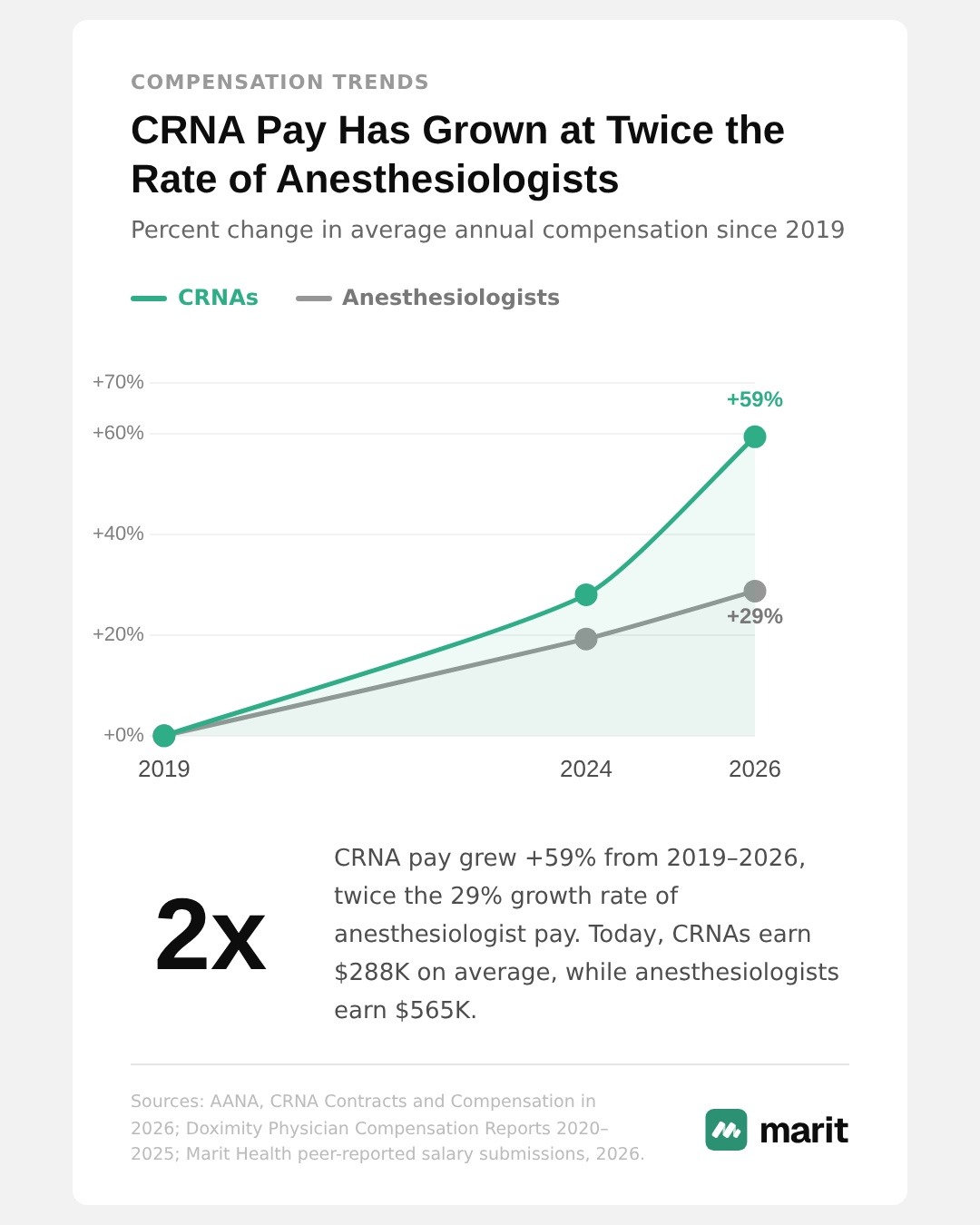
The average physician anesthesiologist earns nearly $565,000 annually, nearly twice the $288,441 average for CRNAs. As the anesthesiologist workforce contracts and demand for anesthesia coverage grows, hospital finance teams managing tight margins have an economic case to staff CRNA-heavy care teams. One physician anesthesiologist overseeing multiple CRNAs in a care team model allows hospitals to cover more procedure rooms at a lower cost per case. In markets where anesthesiologist recruitment has slowed, that model has shifted from a preference to a necessity.
But the cost equation is becoming more complicated. CRNA salaries have grown 59% since 2019, nearly twice the rate of physician anesthesiologists at 29%. The absolute gap remains wide, but the rate of change is compressing the economic advantage of CRNA-heavy staffing faster than most health system finance teams have accounted for.
A significant driver of that compression is widespread availability of locum tenens work, where CRNAs can earn contract rates of $190 to $250 per hour and above. CRNAs became more willing to leave underpaying-but-stable W-2 jobs in favor of having control over their hours and higher compensation. Hospitals faced a direct choice: raise salaries for permanent staff or lose anesthesia coverage to the contract market entirely. Compensation benchmarks rose quickly, resulting in a new compensation baseline that did not exist five years ago.
5. Independent practice authority is an important factor
CRNAs can practice without a supervising anesthesiologist in all 50 states. More than 25 states have opted out of the CMS physician supervision requirement, allowing CRNAs to bill Medicare and Medicaid without physician oversight. Several states advanced legislation in 2025 to expand that further. In non-opt-out states, the requirement is typically collaboration with the operating physician (the surgeon, dentist, or podiatrist), not an anesthesiologist.
Ambulatory surgery centers, rural hospitals, and outpatient clinics across the country have built CRNA-centric staffing models, creating pockets of local demand that aren’t always clear in national projections. CRNAs already make up over 80% of anesthesia providers in rural counties, often as the only anesthesia coverage available. In those markets, a CRNA shortage could limit surgical access for entire communities.
This dynamic shapes CRNA negotiating power. Where a CRNA is the sole anesthesia provider, that provider is negotiating as a solo revenue-generating clinician, with the full economic weight of OR productivity behind the position. This structural change will continue to drive compensation up regardless of what happens with the other four forces.
What It Means
The CRNA shortage is structural. The AANA projects a shortage of approximately 12,500 anesthesia providers by 2033, representing nearly 22% of the current workforce. Expanding doctoral programs helps at the margins, but the pipeline produces graduates years from now, and those graduates enter a workforce still absorbing the retirements of the generation ahead of them.
For CRNAs, a structural shortage in a high-revenue specialty creates negotiating leverage. CRNAs who know what peers in comparable markets are earning are better positioned to evaluate offers, negotiate contracts, and weigh whether a locums arrangement is worth the trade-offs. Salary transparency is how that information circulates.
What hospitals, health systems, and policymakers should recognize is that CRNAs are no longer just a cost-effective supplement to physician anesthesiology. In much of the country, they are the primary anesthesia workforce. Compensating them accordingly, supporting independent practice, and investing seriously in training capacity are not optional strategies. The engine of the hospital depends on it.
Help increase salary transparency and gain access to 27,000+ peer-reported salaries along with MGMA and AMGA data. Submit your compensation data here.