Physicians Prioritize Lifestyle Over Pay: Where Doctors Search for Jobs

Doctors searching for a new job want to move to the South and West. Most look for lifestyle fit in states that cost more and often pay less.
The labor market is facing a projected shortage of up to 86,000 physicians by 2036. To understand where doctors want to go, Marit Health analyzed job search behavior by 18,000 clinicians to map the migration of medicine's workforce. And doctors are willing to move. More than two in three (67%) physician job searches on Marit target a role in another state.
Interest flows out of the Northeast and Midwest and toward the South and West. New York is the country's largest exporter of physicians, due in large part to its training outflow.
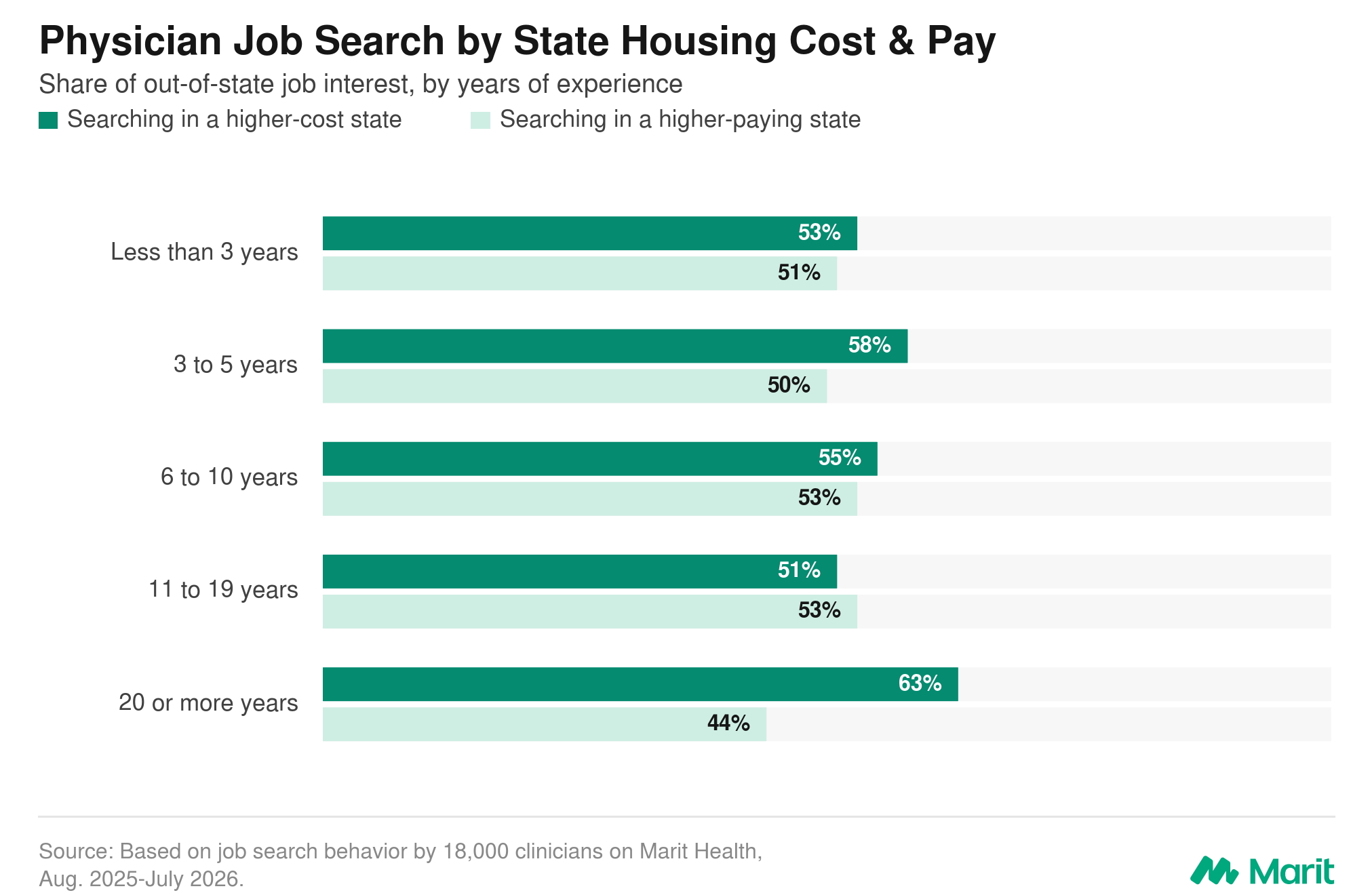
Doctors tend to prioritize states with higher quality of life, rather than a purely financial motive. Among doctors looking for an out-of-state role, more than half are looking in states that have higher housing costs, and in states that, on average, don’t pay much more.
Key findings
- Among physicians looking out of state, 55% target a higher-cost state, rising to 63% for the most experienced doctors.
- Higher cost does not mean higher pay. Where physicians do move toward better-paying states, the raise stays small, and physicians with 20 or more years of experience typically move to lower-paying states.
- California, Florida, Colorado, Georgia, and North Carolina draw the most physician interest. New York, Pennsylvania, Virginia, Indiana, and Louisiana lose the most.
- New York is the source for the top three busiest long-distance corridors: New York to Florida, New York to California, New York to Texas
- Physicians look for jobs out of state the most: 67% of their job interest points out of state, versus 50% for nurse practitioners, 48% for CRNAs, and 43% for physician assistants.
- Rural states hold the most open positions per resident, and none of them draw net interest.
Physicians choose more expensive states, and it isn't about the money
The conventional migration story is affordability: workers leave high-cost metros for cheaper ones where a paycheck stretches further. High earners run the other way, toward expensive cities that pay more. Physicians fit neither version. Among practicing physicians considering an out-of-state role, 55% look at a state with higher home prices than their own. The same holds for nurse practitioners and physician assistants.
The obvious assumption is bigger paychecks. But, just over half of practicing physician job seekers (52%) target higher-paying states, and the raise usually stays small: a median gap of roughly $1,000 to $2,000 for early-career physicians, a trivial amount against a physician's total compensation.
Doctors with 20 or more years of experience typically move toward lower-paying states, with a median gap of about $9,000 below what they could earn by staying. For experienced physicians, quality of life likely outweighs both cost of living and compensation as the reason to move.
Where physicians want to go, and where they're leaving
Some states draw far more physician interest than they lose, and others lose more than they draw. These rankings show where the physician workforce is headed.
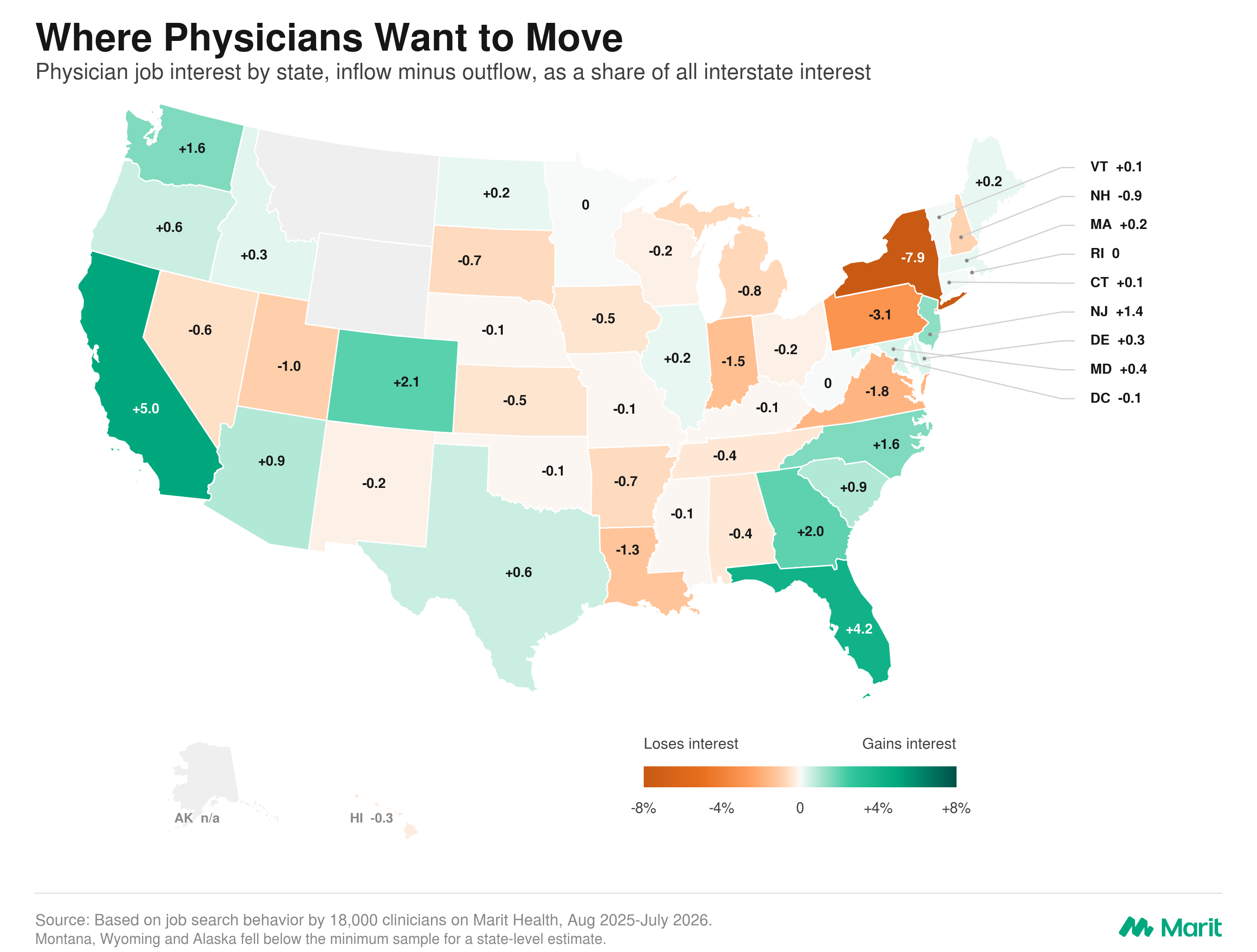
Top destination states (gaining the most physician interest):
Top departure states (losing the most physician interest):
Roughly balanced (interest in and out is about even):
California is the top-ranking state for physician job search interest, pulling largely from New York, Pennsylvania and Texas. While it has lost domestic residents for years, physicians are likely interested in the state due to high quality of life. Three of the top five destinations are in the South. Florida has an older population and the second-largest number of open physician positions in the country. North Carolina has more open positions per resident than any other state on this list. Georgia's growth centers on Atlanta, a hub for large employers.
The busiest state-to-state corridors
The single busiest routes are short hops within the New York, New Jersey, and Pennsylvania tri-state area. Beyond the short distances, the long-distance corridors skew coastal: mostly East Coast to West Coast, or Northeast to South. These are the top long-distance corridors, ranked by each route's share of all out-of-state job interest.
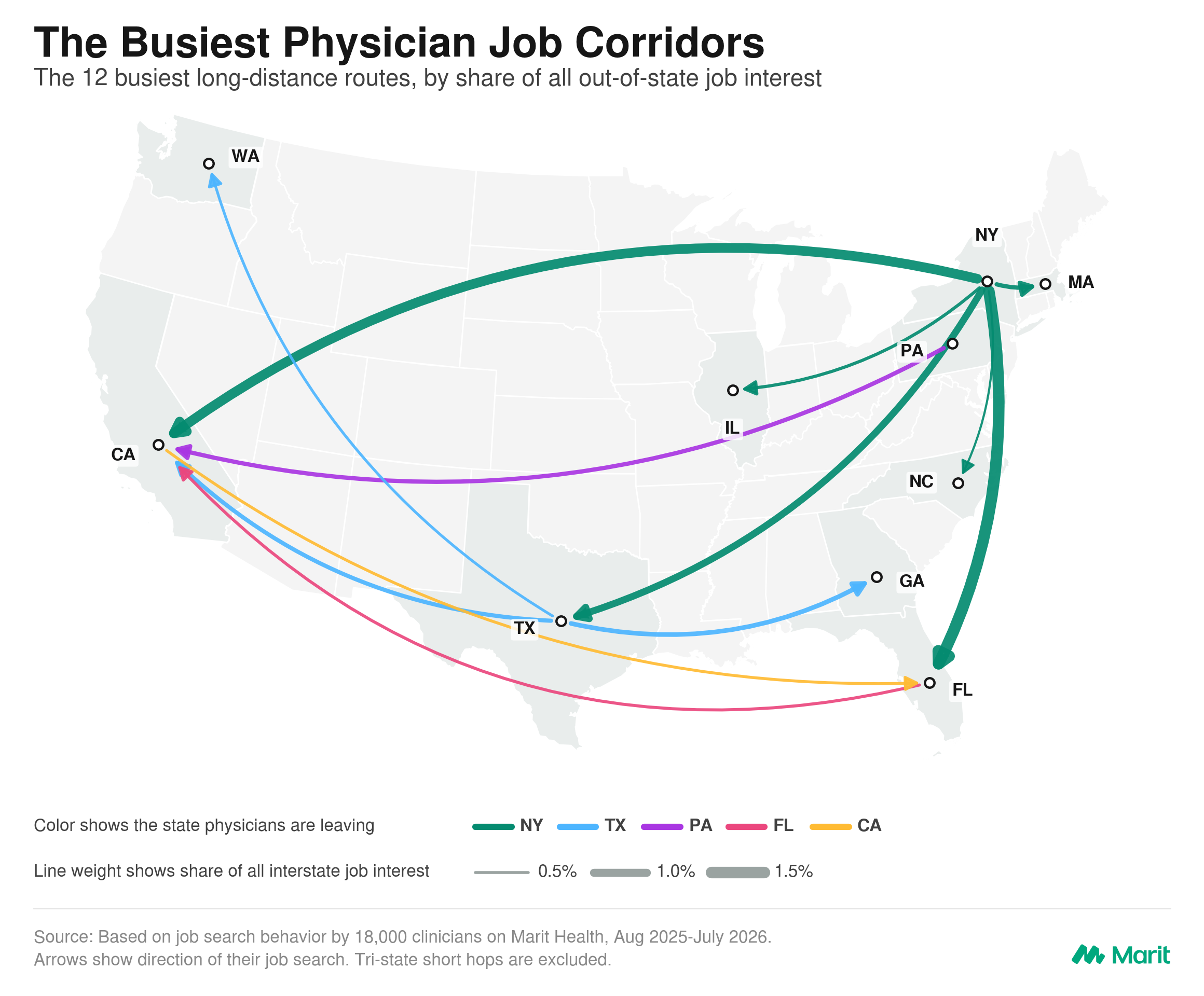
Four of the five busiest long-distance corridors start in New York, and that outflow skews early-career. The state trains more physicians than any other, offering 5,098 residency positions in the 2025 Match, close to 12% of every slot in the country. States that produce that many residents will have higher outflow due to physicians moving on once training ends.
Migration trends by profession and experience
More than two in three (67%) physician job searches on Marit target a role in a state other than where the physician lives. That’s higher than any other clinician: 50% for nurse practitioners, 48% for CRNAs and anesthesiology assistants, and 43% for physician assistants. Looking at experience, physicians still in training move most readily, at 76% for fellows and 70% for residents against 65% for practicing physicians. Physicians with 20 or more years of experience look out of state 57% of the time.
The specialties most likely to look out of state
Out-of-state interest varies widely by specialty, and the size of the local job market explains much of it. Hematology oncology is a small field with heavy demand, so a physician looking for the right opportunity searches across state lines. Pathology and podiatry both have large workforces and few open positions, so the search is typically at the national level. Physicians in large specialties like family medicine, psychiatry, emergency medicine, and OBGYN look for roles out of state less.
Rural states with the biggest demand draw less interest
There is a gap between where physicians search and where there is the biggest need for doctors. By open positions per resident, the greatest need sits in the Mountain West and Northern Plains. North Dakota, South Dakota, Vermont, West Virginia, Maine, Montana, and New Mexico all run well above every state on the destination list, and appear lower on the list for the states that draw physician interest.
Montana, Wyoming, and Alaska together offered 73 residency positions in the 2025 Match, against New York's 5,098. Roughly half of physicians end up practicing in the state where they trained, so a state with almost no residency programs has to recruit nearly its entire physician workforce from somewhere else.
To draw more interest, employers in these states tend to pay more and offer significant benefits like sign-on bonuses and student loan forgiveness.
Where the physician workforce goes next
Physicians are the most mobile clinicians in medicine. They are looking to leave the Northeast and Midwest for the South and West, and they are drawn to more expensive states even when the paycheck does not follow. For the states losing them, and the health systems trying to hold onto them, where physicians want to go next is a leading signal of where the workforce itself is headed.
To find your next role, search for jobs on Marit.
Methodology
This analysis draws on 369,900 job-search actions by 18,000 clinicians on Marit Health between August 2025 and July 2026. An "action" is any signal of interest in a specific job posting: an application, a save, or a view. The analysis weights saves and views by the inverse mean ratio per application, so the strongest signals count for the most.
State rankings normalize as inflow minus outflow, so volume alone does not favor larger states. Location, specialty, and years of experience come from self-reported profiles. State cost uses state-level median home values as of June 2026, from Zillow. Compensation comparisons use Marit's own peer-reported salary data, controlling for specialty. Unless otherwise noted, findings require a minimum of 1,000 actions; state-to-state flows require a minimum of 500.
This data captures physicians who are already searching for a new role, not the full physician population. It measures stated interest rather than completed moves.