The Radiology Shortage AI Was Supposed to Prevent


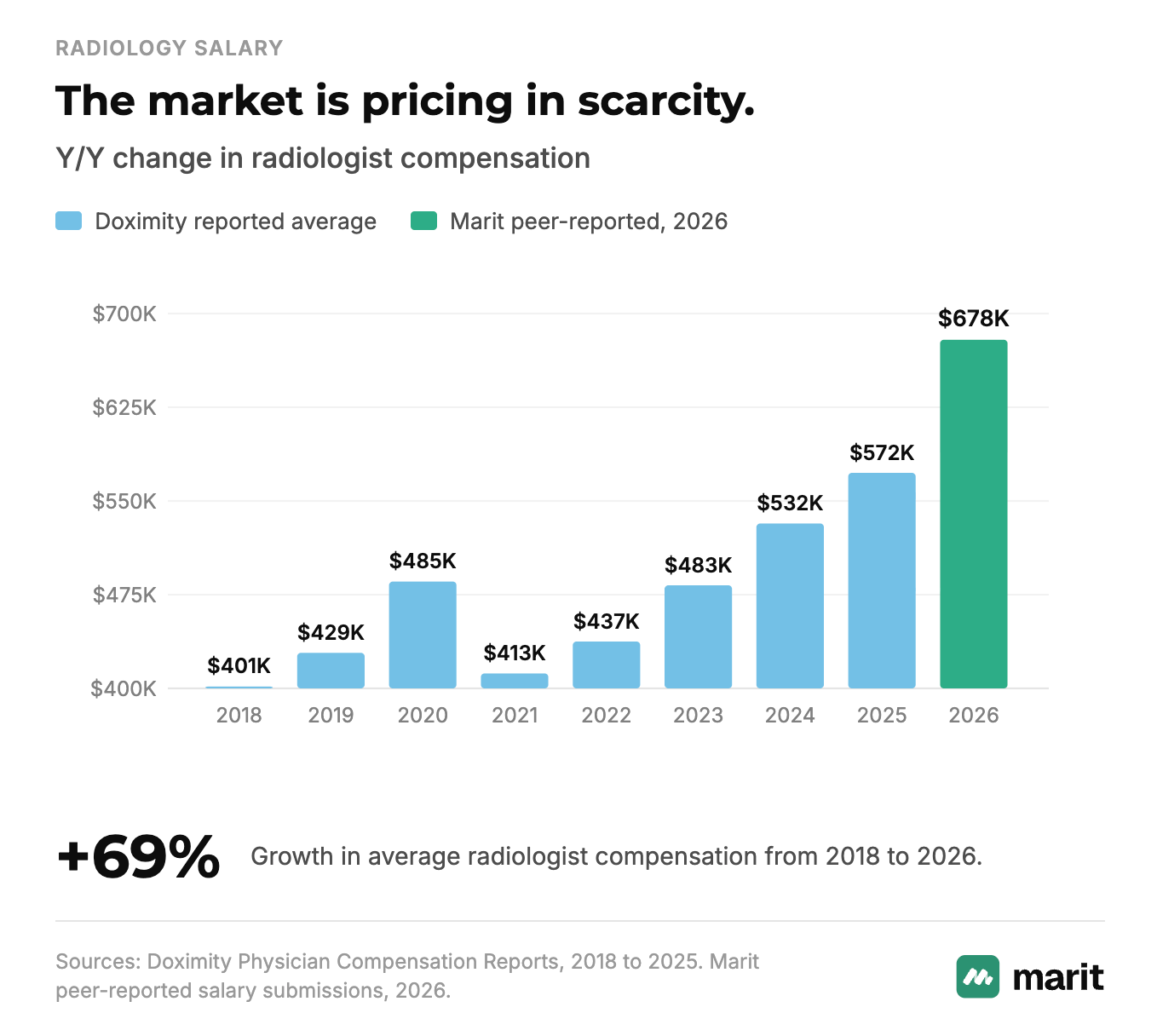
A decade ago, a legendary AI researcher told the world that radiologists would be obsolete within five years. Medical students believed him and stopped applying. But imaging demand didn't get the memo. Volume kept climbing, productivity gains never arrived, and radiology is now one of the hardest specialties to fill in American medicine. Average compensation has climbed to $678,000 a year. The prediction didn't prevent a shortage, it caused one.
In 2016, Geoffrey Hinton stood in front of a room full of computer scientists at the Machine Learning and Market for Intelligence Conference in Toronto and made a prediction that would reshape an entire medical specialty. Hinton was not a random commentator. He is the deep learning pioneer whose work on neural networks had reshaped computer vision, and when he spoke, people listened.
"People should stop training radiologists now. It's just completely obvious that within five years deep learning is going to do better than radiologists.”
It was a confident take, and at the time, an understandable one. But the prediction was way off and ended up becoming an input to the market it was describing.
A decade later, the radiology shortage is one of the most acute physician shortages in American medicine. The AAMC projects a shortfall of up to 124,000 physicians by 2034, and radiology is consistently named among the specialties with highest demand and lowest supply. Average compensation is climbing at a pace that would make a software engineer envious.
How did the field that AI was supposed to automate become one of the highest-paid, hardest-to-fill specialties in medicine?
Demand kept compounding
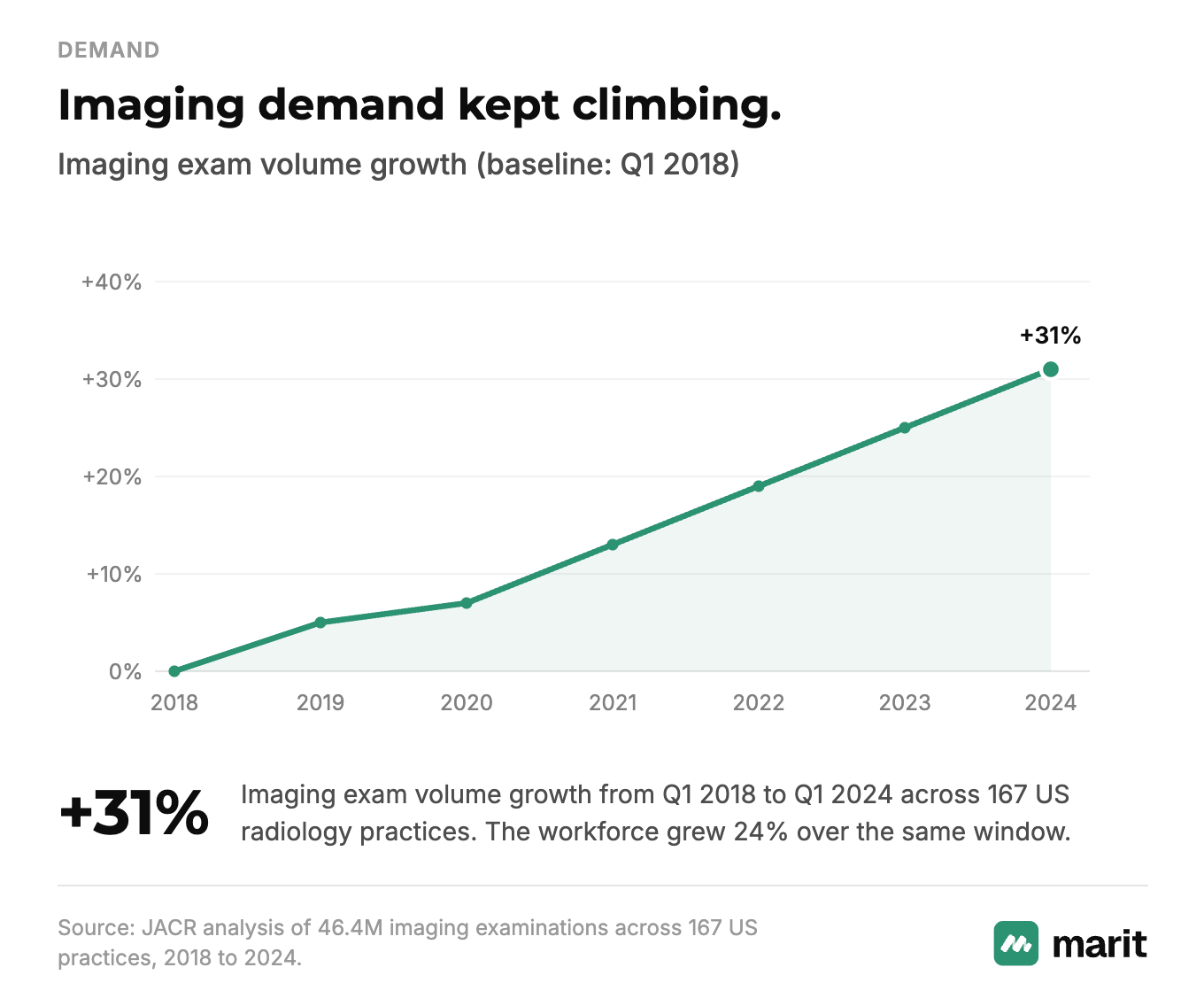
Clinicians order more imaging every year. A recent JACR study analyzing 46.4 million imaging examinations across 167 U.S. radiology practices found that exam volume grew 31% from Q1 2018 to Q1 2024, a compound annual growth rate of 4.6%. While that growth may sound manageable, it isn’t without a growing workforce.
There are more studies, more complexity per study, but not proportionally more radiologists.
Students got scared off
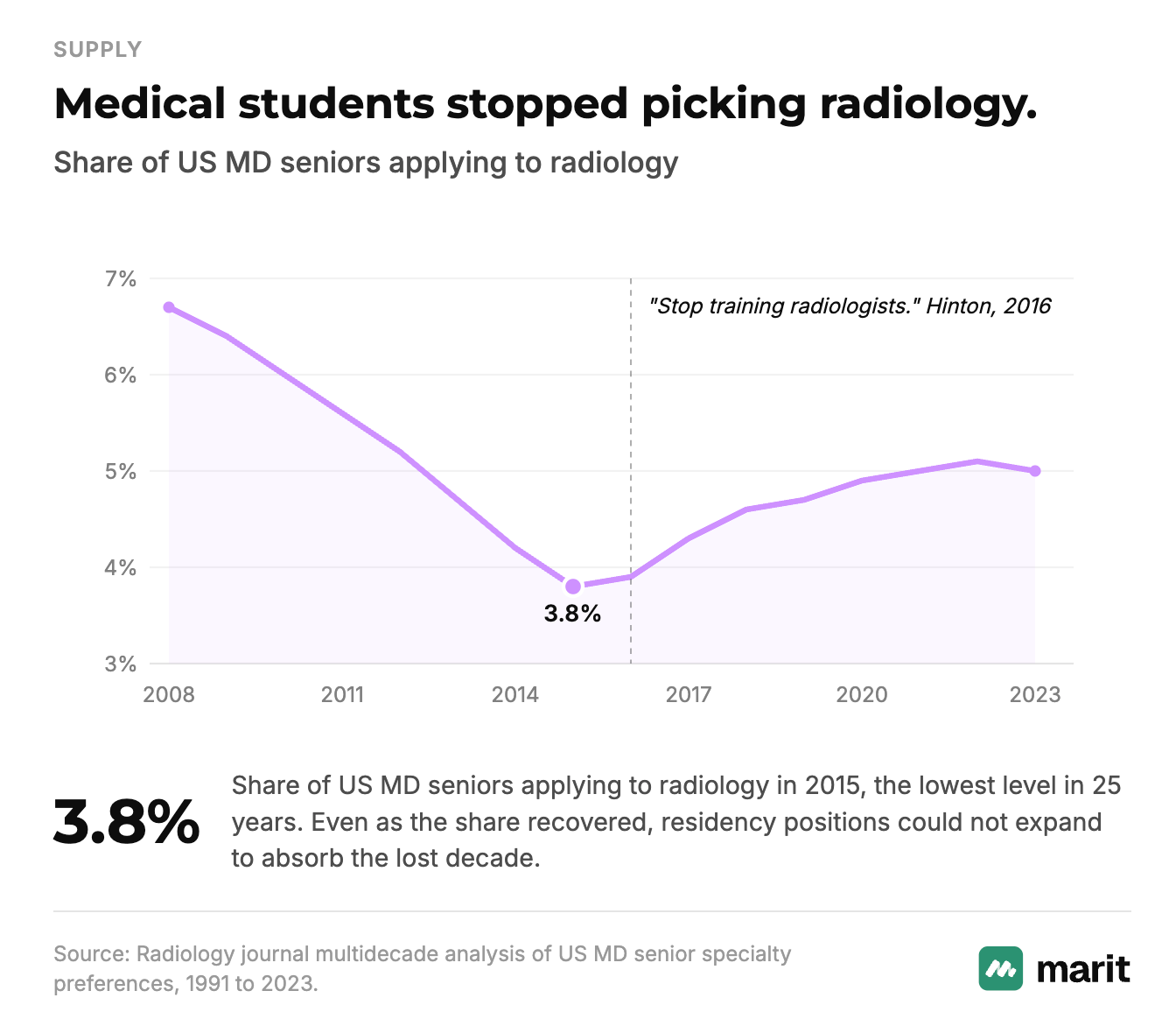
Medical students are rational actors. From 1991 through the early 2000s, roughly 5-7% of U.S. MD seniors applied to radiology each year. By 2015, that share had fallen to 3.8%, the lowest in 25 years. Then came Hinton's prediction, alongside an editorial in the New England Journal of Medicine arguing that "machine learning will displace much of the work of radiologists." Major outlets ran headlines about radiology being the first specialty to be automated away. Students picked something else.
Even as application rates recovered in later years, the residency pipeline couldn't respond. The Balanced Budget Act of 1997 froze Medicare-funded residency positions, and Congress didn't meaningfully expand the cap until 2021. Of the first 200 new positions added under that expansion, only six went to diagnostic radiology. From 2010 to 2025, total U.S. medical residency positions grew 69%. Radiology positions grew just 33%.
The efficiency gains never arrived
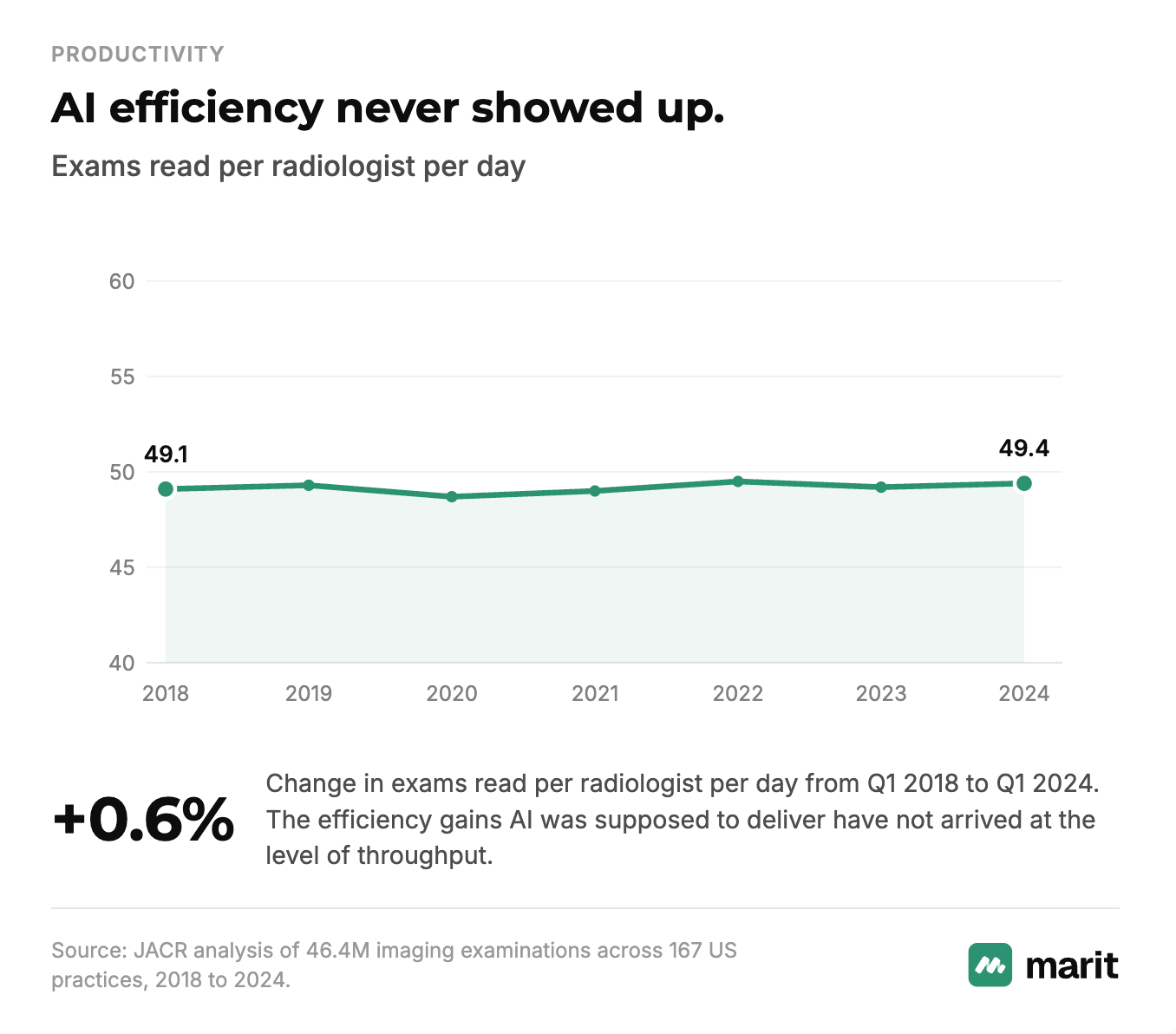
If you had asked any reasonable observer in 2016 what a decade of AI would do to radiology productivity, the answer would have been: dramatically increase it. That is not what happened.
According to the same JACR study, the average radiologist read 49.1 examinations per day in Q1 2018. By Q1 2024, that number was 49.4. Six years of frontier AI development, hundreds of FDA-approved imaging algorithms, and less than one percent aggregate productivity gain per radiologist.
Even with AI efficiencies, radiologist demand will go up, not down. That’s because of Jevons paradox: making something more efficient doesn't reduce how much of it gets used. It typically increases use, because efficiency makes things cheaper and more accessible. That said, Ben White, a practicing radiologist who has written extensively on this topic, argues the current data simply doesn't support the story of Jevons paradox. Interpretation efficiency hasn't actually improved. Scan acquisition is faster, but the cognitive work of reading studies and communicating findings hasn't been compressed by AI in any measurable way.
Most FDA-approved AI models in radiology cluster around a small number of high-volume use cases: stroke, breast cancer, lung cancer. Those represent roughly 60% of approved models but a small fraction of actual imaging volume. For the long tail of tasks radiologists spend most of their time on, AI either doesn't exist or isn't trusted enough to remove a human from the loop.
The market priced in scarcity
From 2018 to 2022, average radiologist compensation grew from $401,000 to $437,000, roughly 2% annually. But in the past four years, the average radiology salary jumped to $678,000, with significant compensation packages like sign-on bonuses of $50,000. Just behind the lucrative surgical specialties and cardiology, radiology is suddenly one of the highest-earning specialties in medicine. It’s a striking position for a field that, a decade ago, medical students were advised to avoid. This is what markets do when supply can't meet demand and there's no easy way to add more supply.
What the prediction taught us
Radiology isn't the last specialty AI will "come for." Pathology is in the same conversation now. Dermatology has been on the list for years. Cardiology will follow.
The lesson isn't that AI forecasts are useless. But they are certainly premature and they're inputs to an extremely interconnected system. And if the prediction is wrong about timing, it doesn’t just incorrectly describe the future, it distorts it.
This is why radiologists are in high demand today, and they’re paid like it.