Anesthesiology is entering a demographic crunch. More than half of practicing anesthesiologists are 55 or older, and industry workforce projections point to a shortfall of thousands of physicians within the next decade as that generation retires faster than training programs can replace them. Demand isn't slowing to match: surgical volume keeps climbing, and non-operating room anesthesia care in endoscopy suites, cath labs, and interventional radiology has become its own growth market. That mismatch is reshaping how employers compete for anesthesiologists, from partnership tracks to schedules built around less call.
Marit analyzed more than 4,000 active anesthesiology job listings to determine the Top 10 Anesthesiology Jobs Hiring Now across three employer types: academic, health systems, and medical groups.
A top anesthesiology listing is transparent about pay, spells out shift structure and call frequency, and details the benefits that come with the role, giving candidates what they need to make a career decision with confidence.
Several of the highest-ranked academic listings post compensation and benefits that rival or beat private practice.
Valley Children's Healthcare leads the list with a pediatric cardiac anesthesiologist role in Madera, California, that can earn more than $1.1 million annually with productivity pay, built around a fixed schedule of 154 in-house shifts a year at 12 hours each. Northern Light Health ranks second with a pediatric anesthesiologist role in Bangor, Maine, pairing a $620,000 base with uncapped student loan reimbursement of up to $20,000 a year and both J-1 and H-1B visa sponsorship. RWJBarnabas Health, tied for second, offers a Toms River, New Jersey role where one extra shift a week, worked 44 weeks a year, is estimated to add $150,000 to total pay. Parkview Health, tied for third, lists a Fort Wayne, Indiana pediatric role with earning potential above $1 million annually, while Westchester Medical Center Health Network, also tied for third, includes a $150,000 sign-on bonus, Public Service Loan Forgiveness eligibility, and pediatric call taken from home rather than in the hospital.
Medical University of South Carolina ranks fourth in Georgetown, South Carolina, with PSLF eligibility, one-on-one student debt counseling, and AI-enabled documentation tools built into its Epic system. Baylor Scott & White Health ranks fifth in Temple, Texas, with a $100,000 sign-on bonus, employer retirement contributions of up to roughly $40,000 a year, and a $300-an-hour rate for work after 4 p.m. AtlantiCare rounds out the middle of the list with a $100,000 sign-on bonus and up to $25,000 in additional annual bonus potential in Atlantic City, New Jersey.
Shriners Children's, in Dayton, Ohio, stands out with a Monday-through-Friday schedule with rare evening and weekend cases, both full- and part-time options, and voluntary pet insurance among its benefits. UPMC's Altoona, Pennsylvania cardiothoracic role builds in raises at the two- and five-year marks, from $562,000 to $602,000, alongside 10 weeks of PTO. Montefiore Health System and Beth Israel Lahey Health round out the top 10; the Beth Israel Lahey listing, in Plymouth, Massachusetts, includes a $50,000 sign-on bonus and access to a surgical suite handling more than 20,000 cases a year.
Health systems on this list lean into predictability: fixed shifts, capped call, and in several cases, no call at all, a notable departure from anesthesiology's usual on-call demands.
Rochester Regional Health leads with a Rochester, New York role paying $400,000 to $600,000, plus a $100,000 sign-on bonus and a second $100,000 retention incentive paid out over four years. Trinity Health Mid-Atlantic Medical Group and Universal Health Services tie for second: Trinity's Muskegon, Michigan cardiac anesthesiologist role is paid hourly, $325 an hour for in-house shifts and $365 for additional shifts, plus up to $75,000 a year in value-based incentive pay, while Universal Health Services' Reno, Nevada position offers full financial partnership from day one, pay up to $800,000, and call limited to roughly one night in 15.
Centracare, in Willmar, Minnesota, ranks third with an explicit no-call, no-nights, no-weekends practice model. AdventHealth and Tucson Medical Center tie for fourth: AdventHealth's Calhoun, Georgia listing pairs a $550,000-to-$650,000 range with newly renovated operating rooms, while Tucson Medical Center offers a $50,000 sign-on bonus tied to a three-year commitment and loan forgiveness. Rutland Regional Medical Center ranks fifth in Rutland, Vermont, with 10 weeks of paid vacation and weekend call limited to Friday through Sunday, most of which is covered by a dedicated team.
Sutter Health, ranked sixth in Tracy, California, offers a two-year track to shareholder status and a 401(k) contribution equal to 12 percent of pay. Community Health Systems ranks seventh in Dothan, Alabama, with a no-call model built around one 24-hour in-house shift and three 8-hour shifts a week, plus a choice between $550,000 on a W-2 basis or roughly $675,000 annualized on a 1099 basis. Endeavor Health closes out the list in Arlington Heights, Illinois, at a 563-bed teaching hospital.
Several of the highest-ranked medical group listings compete on schedule as much as pay, with explicit no-call and no-weekend guarantees showing up in roles that would typically carry a heavy call burden.
Envision Healthcare leads in Glendale, Arizona, with a fixed three-shift week, no weekends, no overnight call, and a $415,000 base plus a $120,000 bonus package. Somnia Anesthesia ranks second in San Bernardino, California, at $634,920 with a $20,000 sign-on bonus and the option to choose a day-shift schedule with no call or weekends. TeamHealth ranks third with a traveling anesthesiologist role paying $650,000 to $750,000, a $70,000 signing bonus, and 12 weeks of PTO, well above the norm for the specialty.
Spectrum Healthcare Partners, in Portland, Maine, ranks fourth in a physician-owned, physician-governed group paying upward of $600,000 with call averaging only one weekday a week. National Partners in Healthcare and Sound Physicians tie for fifth: National Partners' Las Colinas, Texas role is tagged partner-eligible, though without a stated timeline, while Sound Physicians offers a $350-an-hour guaranteed PRN role in Kansas City. CASE Medical Group ranks sixth in Sacramento with the most explicit partnership structure on the list — a two-year path to shareholder status, compensation reaching $650,000 to $850,000, and post-partnership profit sharing the listing describes as well above market.
360 Anesthesia, in Binghamton, New York, ranks seventh with a comparatively standard benefits package. Vertex Anesthesia ranks eighth in McKinney, Texas, with no call and no weekends built into a $500,000-to-$600,000 role. Premier Anesthesia ranks ninth in Jackson, Tennessee, with a $610,000 base plus $117,000 in call pay and 17 weeks of time off, the most PTO of any listing in this analysis. Anesthesia Company, LLC rounds out the top 10 in Annapolis, Maryland, with a three-year partnership track that builds to 90 percent of partner income after the first year, plus a $100,000 sign-on bonus.
What Anesthesiologists Earn
Anesthesiology remains one of medicine's highest-paid specialties, though pay varies more by employer type and subspecialty than by geography. The median total compensation for anesthesiologists in the U.S. is $556,000, with the middle half of earners falling between $500,000 and $630,000.
Subspecialty matters more than many anesthesiologists might expect. Cardiac anesthesiologists post the highest average compensation among tracked subspecialties, at $605,000, while OB anesthesiologists average $451,000, more than $150,000 lower. Pediatric anesthesiology ($568,000), pain medicine ($558,000), regional and acute pain ($549,000), addiction medicine ($548,000), and critical care ($541,000) all cluster closer to the specialty-wide median.
Employer type cuts a different way than many assume: academic anesthesiologists average $544,897, compared to $574,088 outside of academic medicine. MGMA's 2026 benchmarks show a similar pattern, with academic compensation ($482,047) rising faster year-over-year (+8.0%) than non-academic pay ($594,186, +2.9%), narrowing, though not closing, the gap.
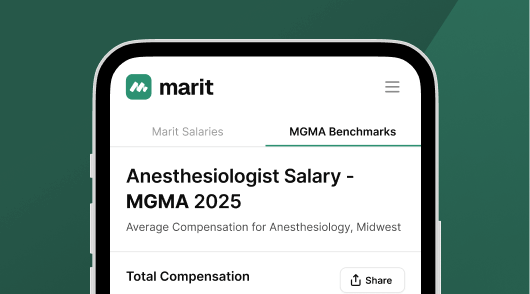
For anesthesiologists evaluating an offer, these figures are a starting point. Marit's compensation intelligence platform includes peer-reported salary data across anesthesiology subspecialties, with MGMA and AMGA benchmarks accessible to clinicians who want to know where an offer falls in the range.
Methodology
The list of Top Anesthesiology Jobs Hiring Now includes active anesthesiologist job listings on Marit as of July 28, 2026. To qualify, a listing must include expected compensation and work schedule or shift details. Jobs are assigned a predicted salary using a statistical model based on specialty, location, employer type, and workload. Jobs are ranked by how much their listed compensation exceeds that predicted salary, holding other factors constant. Listings that do not share on-call schedule or benefit details, including signing bonus, retirement plan access, paid vacation, or paid parental leave, are penalized in the ranking. Listings with wide or ambiguous compensation ranges are also penalized. The list excludes locum tenens roles. Only the top-ranked active listing per employer was included in cases where a single employer had multiple roles on a list. For questions about the methodology, contact press@marithealth.com.